Overview
JPS helps overseas buyers purchase eligible items in Japan and ship them internationally.
The workflow is designed around two separate stages:
This keeps the cost structure easier to understand.
- purchase in Japan
- international shipping after warehouse arrival
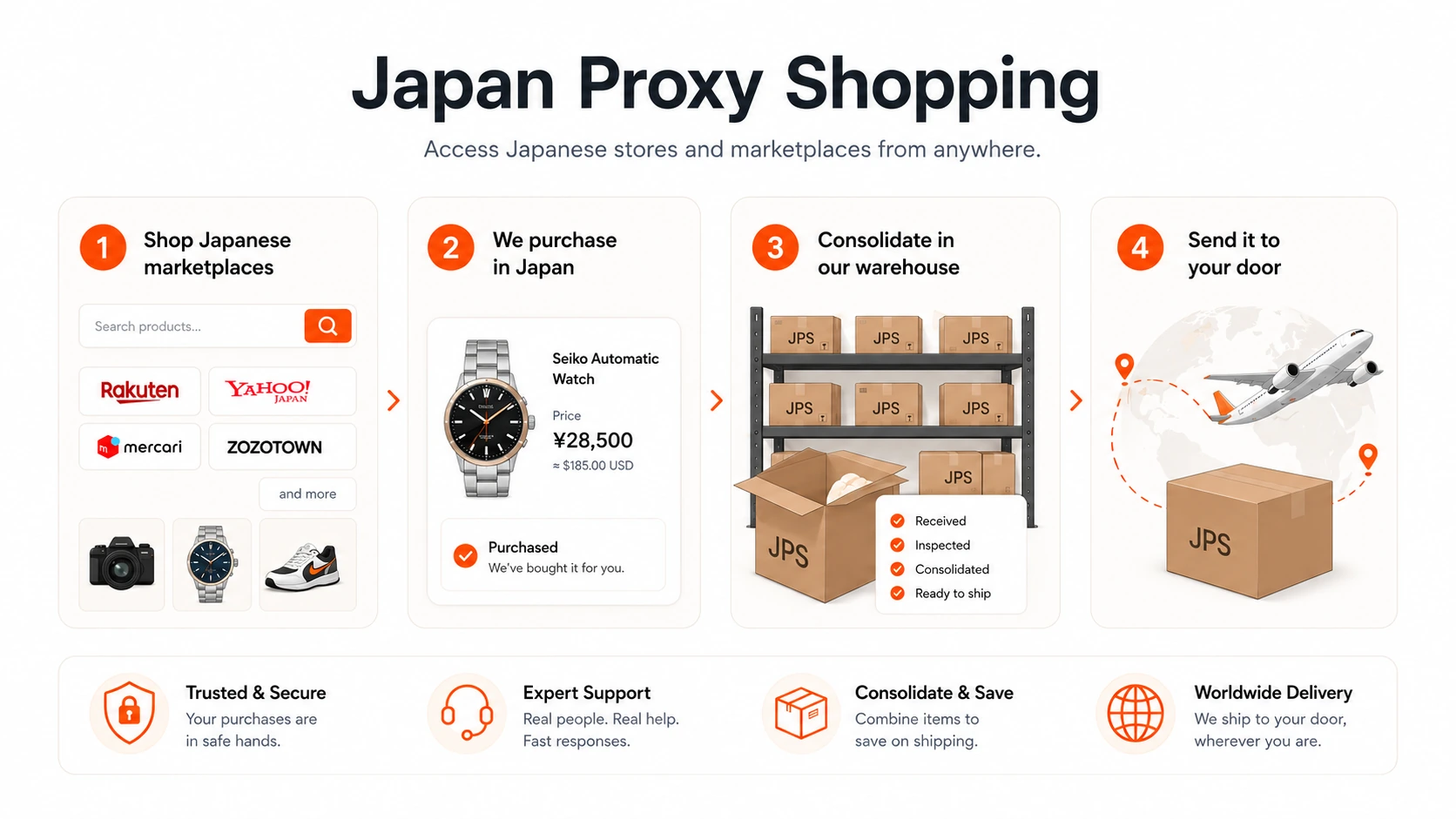
Buy eligible products in Japan
Customers can use JPS for supported Japanese marketplaces and stores.
For eligible stores outside the standard marketplace list, Buy by URL may be available.
Before purchase, confirm the exact product, seller or store, variation, quantity, condition, included accessories, and Japan domestic shipping.
Purchase-stage cost
JPS charges ¥300 per purchase request.
The customer also pays the item price and actual seller Japan domestic shipping.
International shipping is paid later.
Warehouse storage
After the seller sends the item to JPS:
Detailed inspection, testing, and professional authentication are not included in the standard service.
- basic receiving check is included
- 60 days of warehouse storage are free
- optional item photos cost ¥500/item
Free consolidation
Eligible orders can be combined for ¥0 consolidation fee.
This is useful for buyers purchasing from several Japanese sellers or stores.
Packing
Final international parcel packing starts from ¥500.
Packing is charged per outbound parcel.
International shipping
JPS charges actual carrier rate — no JPS markup.
The rate is determined after the final parcel weight and dimensions are known.
Carrier protection
Carrier shipping protection applies according to carrier terms.
JPS assists with eligible carrier claims.
Why two-stage payment matters
At the purchase stage, JPS knows the item price, domestic shipping, and proxy fee.
It does not yet know the final international parcel.
The second payment is therefore based on the actual packed shipment.
JPS pricing summary
- Proxy purchase fee: ¥300 per purchase request
- Japan domestic shipping: actual seller charge
- Storage: 60 days free
- Consolidation: free
- Packing: from ¥500
- Photos: ¥500/item
- International shipping: actual carrier rate
- JPS shipping markup: ¥0