Overview
International shipping is one of the hardest costs to estimate before a Japan purchase reaches the warehouse.
That is because the final rate depends on the finished parcel, not only on the product page.
JPS calculates international shipping after the parcel is packed.
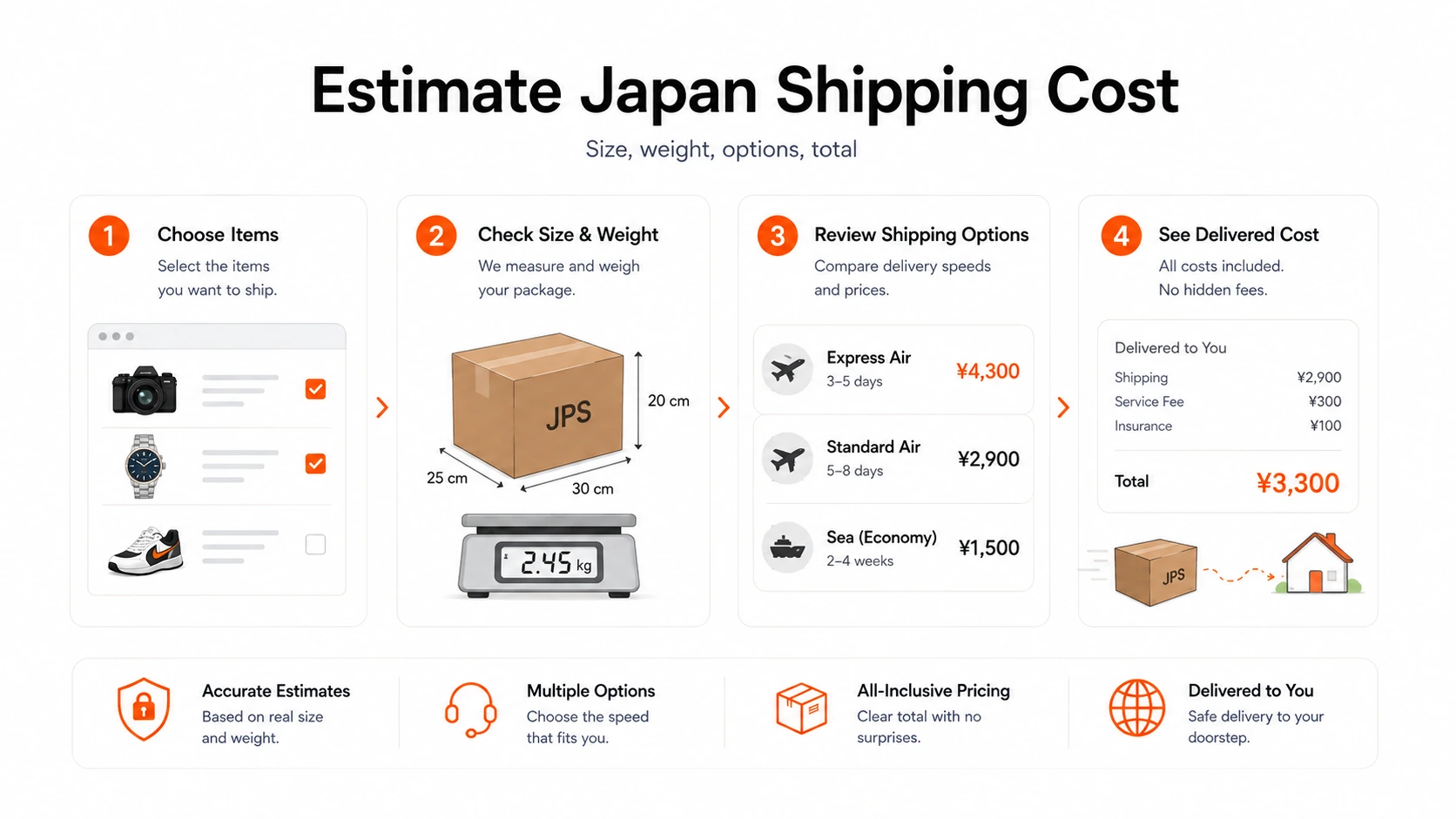
What determines the shipping cost?
The main factors are:
For bulky products, dimensions can matter more than scale weight.
- actual parcel weight
- parcel dimensions
- destination country
- selected carrier
- product type
- carrier size limits
- dimensional-weight rules
Actual weight vs. dimensional weight
Some carriers compare actual weight and dimensional weight and charge according to the rules of that service.
This matters especially for anime figures, Gunpla, shoes, plush toys, and large collector boxes.
A 2 kg parcel can still be expensive if the carton is very large.
JPS packing fee
International parcel packing starts from ¥500 per parcel.
Packing is separate from consolidation.
JPS consolidation fee
Free
Eligible purchases can be combined into one outbound parcel without a separate consolidation charge.
That means:
- consolidation: ¥0
- final parcel packing: from ¥500
International shipping rate
JPS charges actual carrier rate — no JPS markup.
JPS does not increase the carrier’s international shipping price to create an additional shipping margin.
Example
Suppose the final parcel has:
Optional warehouse services are separate.
- packing: ¥500
- carrier shipping: ¥2,900
- Packing: ¥500
- Consolidation: ¥0
- International shipping: ¥2,900
- JPS shipping markup: ¥0
- Total shipping stage: ¥3,400
Why the final shipping quote comes later
Before the item reaches the warehouse, JPS may not know the seller carton dimensions, protective material required, whether other orders will be consolidated, final outbound size, or battery and restricted-item issues.
A pre-purchase number should therefore be treated as an estimate.
Consolidation does not always reduce cost
Combining several small items usually works well.
But combining several bulky products can create a parcel with high dimensional weight.
Before shipping, compare one parcel, two smaller parcels, packaging preservation, and carrier size limits.
Product examples: Trading cards
Usually compact and inexpensive to consolidate.
Product examples: Books
Compact but heavy.
Product examples: Figures
Often light but bulky.
Product examples: Fishing rods
Long parcels can face carrier limits or oversized rates.
Product examples: Electronics
Dense, with possible battery restrictions.
Carrier protection
Carrier shipping protection applies according to the selected carrier’s terms.
JPS assists with eligible carrier claims.